One of our planned activities whilst here has been to do a ‘Battlefield’ run for Kemm so this morning we headed to another area in Paris ( a hotel at which we will stay one more night when we return from tour), where we met up with out tour group of 16 and set off out of Brisbane to head up to the northern France battlefields.
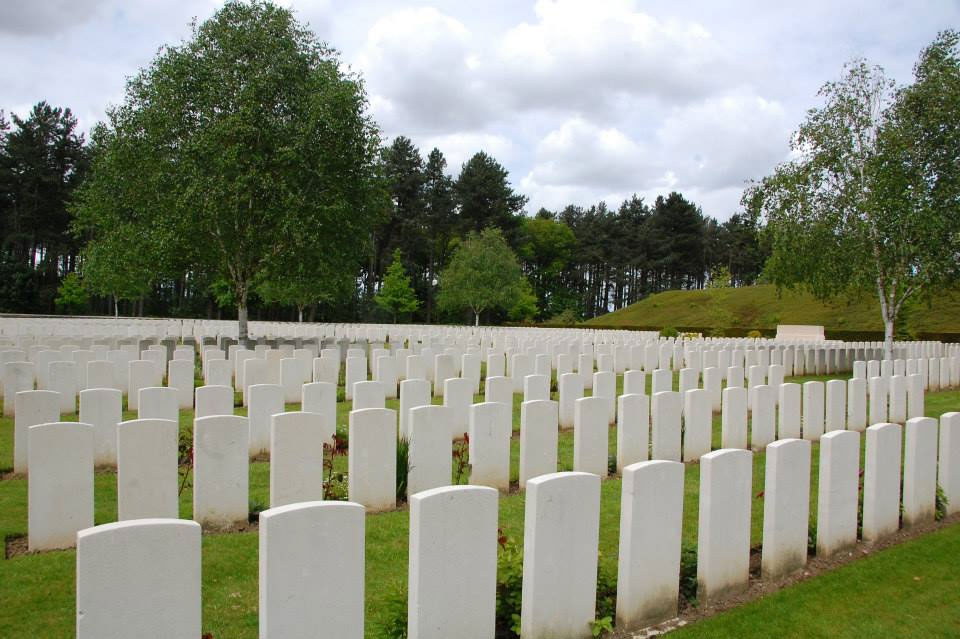
First stop was to Peronne and a British and Indian cemetery with 49 Australian gravesites on site. (Having now read back on this 2 days later, this was just the start of what we are seeing!). Lunch at a nearby cafe then back on the bus and up to Mon St Quentin on the outskirts of Peronne where during World War 1 the Australians reached the 100m high hill and hid up against a high retaining hill then in an outburst of noise and commotion, pushed the Germans off the hill. The Germans has assumed there were a lot more soldiers than there actually were and retreated back.
I’m not fully versed on all of this but the Australian soldiers here were well regarded for their endeavours and as such a memorial has been erected on the hill where this took place. This is all around the area where the “Battle of the Somme” is well known.
Our guide is an extremely knowledgeable UK guide, in his 50’s I guess but he can reel off numbers, battles, dates, nationalities and casualty figures without question – I guess that’s what we’ve paid for! As much as we all think ‘oh yes, that happened in World War 1’, it’s a whole different story actually being here and understanding what really went on.
Next day we headed for the town of Ypres (Iper) Ypres was TOTALLY destroyed in 1915 and has since been totally rebuilt including the Cloth Hall and Ypres Cathedral. Absolutely amazing that in 100 years all these buildings could be rebuilt from the rubble up including the Cathedral and the huge ‘Cloth Hall’. Ypres was a central point for trade and transport during WW1, the buildings are all stone with very high pitch roofs.
Our accommodation for the next 2 nights is here in Ypres and a group dinner for this evening.
This evening though we walked down to the ‘Menin Gate’ – here the names of 6000 soldiers who ‘never came home’ or were never found’ are etched into the walls of the Menin Gate – all nationalities but a huge number of Australian names! At 8pm a solemn service is held EVERY night in remembrance of those who served. It was cold and bitter whilst waiting but as per any Last Post service, very moving. 2 of those in our tour group laid a wreath in remembrance of one of the older ladies’ uncles who died on the battlefields nearby.
Next day we set off on a walking tour of town and over to a beautiful cemetery “Rampart Cemetery” on the banks of a river. A number of Maori gravesides here as well. There are an amazing number of Commonwealth War Graves cemeteries here – all well maintained and usually in delightful garden settings. The number of gravesides of unknown soldiers is astounding! Many of the soldiers bodies were found but had no markings or ID to identify them so they just became ‘An Unknown Soldier of the Great War’. Others, if their nationality was identified, they are then acknowledged as an “Australian Soldier” or “New Zealand Soldier’ etc.
Polygon Woods was our next stop – a copse of woods that was levelled by fighting, as was the whole region – much of the fighting in the area involved having to trudge through slushy mud and horrendous conditions. The Australian and New Zealand forces were a major force in moving the Germans off the ridgelines here to secure the nearby areas. The area around Ypres and Messines Hill to this day holds hidden live armament as just 3 weeks ago 3 construction workers were killed when live ammunition blew up on a site they were working on.
The Polygon Woods cemetery holds the gravesites of the 5 soldiers unearthed in 2006 with 2 of them still currently unnamed. There is a larrge memorial in Polygon Woods cemetery as a memorial to all the New Zealanders whose bodies were never retrieved. The New Zealanders have memorials erected near to where they mostly fell, whilst the Australian name of those never found are all printed on the Menin Gate in Ypres.
Tyne Cot cemetery was our next stop and is the largest cemetery in this region. There are over 12,000 gravesides in this cemetery – 700 being Australians, and all being killed over a period of 2 weeks.
Next stop was to the main German Cemetery at Langemarcke. There are 44,000 bodies burried here, 23,000 in the one single square area but only holding ‘parts’ of bodies. The blocks surrounding this largish square, name 10,000 of those 23,000. Each of the ground plaques throughout the cemetery symbolizes 20 German soldiers.
The numbers of war dead and the conditions in which they fought are amazing and something just so hard to fathom! It must have been horrific.
We will remember them.
